

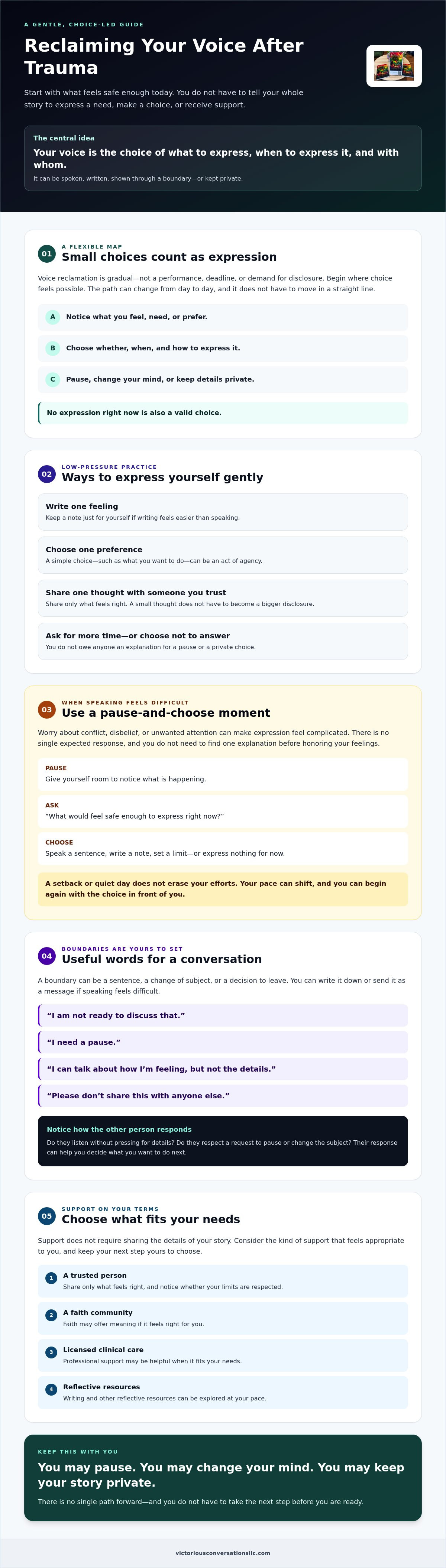
What if reclaiming your voice doesn’t begin with telling your whole story, but with one small choice that feels safe? If you’re wondering how to reclaim your voice after trauma, it can be hard to name what you need, trust your preferences, or speak up when you fear conflict, disbelief, or unwanted attention. You don’t have to force the words. Your pace matters.
Starting gently is not the same as staying silent. Small acts of expression, such as writing down a feeling, choosing what you want, or sharing one thought with someone you trust, can help you notice what feels possible. You’re allowed to pause, change your mind, and keep details private.
This article explores choice-led ways to begin expressing yourself again, while honoring your boundaries and need for support. We’ll look at low-pressure practices, ways to decide whom to talk with, and how writing or faith might offer meaning if they feel right for you. We’ll also consider when trusted or professional support may be helpful. There’s no single path, and you don’t have to take the next step before you’re ready.
Key Takeaways
- Understand how to reclaim your voice after trauma by rebuilding choice in what you express, when you speak, and whom you trust.
- Remember that support and self-expression don’t require sharing the details of your story.
- Explore simple ways to practice expressing preferences and boundaries, and give yourself permission to pause or stop.
- Use a gentle pause-and-choose approach when a conversation feels difficult; a setback doesn’t erase your efforts.
- Consider what kind of support fits your needs, from trusted people and faith communities to licensed clinical care or reflective resources.
How trauma can affect your voice, and why your pace matters
Silence, hesitation, or uncertainty about what you want to say can feel painful, especially if past experiences left you feeling unheard or unsafe. These responses don’t define who you are, and they don’t look the same for everyone. Experiences described as psychological trauma can affect people in different ways; there isn’t one expected reaction or a single path forward.
Voice reclamation is the gradual rebuilding of choice in what you express, when you express it, and with whom. It isn’t a performance or a deadline. If you’re exploring how to reclaim your voice after trauma, you can begin with what feels manageable today, even if that means simply noticing what you prefer.
What does reclaiming your voice mean after trauma?
Your voice is more than the sound you make when you speak. It can include recognizing a need, setting a boundary, making a choice, writing a thought, or sharing a preference. Saying “I’d rather stay home,” asking for more time, or choosing not to answer are all ways of exercising agency.
Self-expression doesn’t require telling your complete personal story. You may share a small detail, keep private what you’re not ready to discuss, or choose not to speak at all. Privacy is valid. So is changing your mind about what you want to share.
Why can speaking up feel difficult?
You might worry that speaking will bring conflict, disbelief, or attention you don’t want. You might know something feels wrong but struggle to find words for it. Or you may feel ready in one moment and uncertain in another. These are possible individual experiences, not a checklist or proof that you’re responding incorrectly.
There may be many reasons expression feels complicated, and you don’t need to settle on one explanation before honoring your feelings. Your pace can shift from day to day. A quiet day doesn’t mean you’ve lost ground, and a small step doesn’t need to lead to a bigger disclosure.
Try asking yourself, “What would feel safe enough to express right now?” The answer might be a sentence spoken to someone you trust, a note kept just for you, or no expression at all for the moment. Begin where choice is possible. Your voice belongs to you, whether it is spoken, written, or kept within your own heart.
Start with safety and choice before sharing your story
Before deciding what to say, remember that the decision is yours. You can choose whether to speak, when to speak, and whom to tell. You don’t owe anyone an explanation, even if they care about you or want to help. Sharing personal details isn’t a requirement for expressing a need or receiving support.
You have the right to set limits on what you share, with whom, and when. That might mean talking about how you feel today without explaining why, writing privately instead of speaking, or deciding that a subject is off-limits. A gentle guide from CPTSD Foundation offers ideas for how to reclaim your voice at your own pace, including seeking spaces that feel supportive.
How can you tell whether a conversation feels supportive?
No conversation comes with a guarantee, but you can notice how a person responds to your limits. Do they listen without pressing for details? If you ask to pause or change the subject, do they respect that request? You might start with someone you trust, and share only what feels right, rather than disclosing because you feel obligated.
Even a caring listener may not respond exactly as you hope. You can decide what you’re comfortable sharing and reassess as the conversation unfolds. If the person dismisses your boundary, that’s useful information for deciding what you want to do next.
What boundaries can help you feel more in control?
A boundary can be a clear sentence, a change of subject, or a decision to leave a conversation. You might say:
- “I am not ready to discuss that.”
- “I need a pause.”
- “I can talk about how I’m feeling, but not the details.”
- “Please don’t share this with anyone else.”
Boundaries can guide which topics you’ll discuss, when you’re available to talk, what stays private, and whether you want further contact. If speaking feels difficult, you can write a phrase down or send it as a message. You can also pause, change the topic, or end the conversation without defending your choice.
Your needs may change. A limit that feels right today can be adjusted later; you’re not making a promise to share more. If you’re considering how to reclaim your voice after trauma, practicing one boundary in a low-pressure moment may help you discover what language feels like your own. Reflective writing and communication resources from Victorious Conversations may offer another way to explore expression, though they aren’t a substitute for professional care.
Use small, low-pressure ways to practice self-expression
You don’t have to begin with a difficult conversation or a major declaration. Everyday choices can offer gentle opportunities to notice what you like, need, or want. Choose only what feels manageable; skip a step or stop at any point. Discomfort isn’t proof that you need to push through.
What small acts can help you practice using your voice?
Try one low-stakes action and see how it feels. You might choose what to eat, state a preference about music, or ask for time before answering a question. A boundary can be practiced privately on paper or, if you feel comfortable, with someone you trust. You can keep it simple: “I’d prefer another day,” or “I need a little time to decide.”
- Notice: What do I prefer right now?
- Choose: Would I like to express it, write it down, or keep it to myself?
- Pause: Do I want to continue, stop, or try something different?
Declining an invitation is also an option. You might say, “Thank you for asking, but I can’t make it,” without giving a reason. If even a small practice feels too much, set it aside. The aim isn’t to prove anything. It’s to give yourself room to make choices.
Can reflective writing support voice reclamation?
Writing can be a private place to notice thoughts, needs, or questions before deciding whether to share them. It doesn’t need to become a polished account of what happened. You could write about what you want today, what you’re unsure about, or what would help you feel more at ease. Keep the page private unless you choose otherwise.
If reflection starts to feel distressing, close the notebook, shift your attention to the present, or stop for now. The National Center for PTSD offers additional guidance on coping with traumatic stress reactions, including approaches to coping and creative expression. Writing is optional, not a test of readiness.
For more writing-focused perspectives, you can explore Processing Emotional Hardship Through Expressive Writing and Journaling and Reflective Writing for Emotional Healing. Let those resources be invitations, not instructions. Learning how to reclaim your voice after trauma can include words spoken aloud, words kept on a page, or the choice to wait until expression feels more possible.
Respond to setbacks with patience, support, and self-compassion
A conversation that leaves you unsettled, or a day when words won’t come, doesn’t erase the effort you’ve already made. Expression can feel easier at some times than others. Instead of judging yourself for a setback, treat it as a moment to pause and choose what you need next.
Try this gentle check-in:
- Notice: What feelings are here right now? You don’t have to explain them.
- Identify: What might help me feel more supported or comfortable?
- Choose: Would I like to pause, write a short message, reach out to someone I trust, or do something else?
These are options, not clinical techniques or guaranteed solutions. If speaking feels overwhelming, you could take a break, move somewhere more comfortable if possible, or ask a trusted person to stay nearby. You can also leave the conversation and decide later whether you want to return to it. You’re allowed to choose what feels manageable.
When might professional support be helpful?
If distress feels difficult to manage, keeps interfering with daily life, or leaves you feeling alone with more than you can carry, consider reaching out to a licensed mental health professional. You can ask about their experience supporting people affected by trauma and whether their approach feels respectful to you. Seeking care doesn’t mean you’ve failed to cope; it’s one way to bring additional support into your life.
If you’re in immediate danger, contact local emergency services or crisis support. In the United States, call or text 988 for the Suicide & Crisis Lifeline.
How can faith fit into a personal journey?
If faith is meaningful to you, prayer, scripture, or connection with a faith community may offer comfort, reflection, or a sense of companionship. You can approach these practices in your own way, or not at all. Distress isn’t evidence of insufficient belief, and faith doesn’t have to replace professional care or other support. For a related perspective, see Why Faith-Based Emotional Healing Books Bring True Hope.
As you consider how to reclaim your voice after trauma, let patience be part of the process. A small step, a pause, or asking someone to sit with you can all be valid choices. If reflective writing or communication guidance feels supportive, explore reflective writing and communication resources from Victorious Conversations. These resources aren’t therapy, and you can choose what fits your needs.
Choose support that respects your story and your next step
Support can take different forms, and each serves a different purpose. A licensed mental health professional can provide clinical care when distress feels difficult to manage or you need help with mental health concerns. Peer support may offer connection with people who share similar experiences. A faith community may provide spiritual companionship if that matters to you. Books and reflective workshops can invite personal exploration, but they aren’t clinical care.
How do you choose the right kind of support?
Begin with what you’re hoping for. Are you looking for clinical guidance, a sense of community, a faith-centered perspective, or space to reflect? Consider your comfort, privacy, and the provider’s qualifications. You can ask what a resource involves before taking part, including whether you’re expected to speak or share personal experiences. You’re free to decline, pause, or choose another kind of support.
If you have clinical concerns, seek a licensed mental health professional rather than relying on a book or workshop. These resources can complement other forms of support, but they shouldn’t take the place of professional care when you need it. You don’t have to choose every kind of help at once.
How can a memoir or workshop offer reflection?
For readers who welcome faith and personal storytelling, Carmen Cotto Santiago’s Victorious… My Conversations with God is a bilingual memoir that brings together personal testimony and biblical passages. Reading someone else’s story may offer ideas to consider, but it isn’t a requirement for healing or a substitute for individualized care. Take what feels meaningful and leave what doesn’t.
Victorious Conversations also offers reflective writing and communication workshops. These are opportunities for reflection and communication practice, not licensed psychotherapy or clinical counseling. You can learn about the scope of a workshop before deciding whether it suits your needs; there’s no need to disclose experiences unless you choose to.
As you explore how to reclaim your voice after trauma, let the right support be the kind that respects your choices and your pace. If a faith-centered memoir or reflective communication resource feels appropriate for you, explore Victorious Conversations’ memoir and workshops. Choose only what serves your next step.
Let your next step be yours
Reclaiming your voice doesn’t require telling everything or moving faster than feels right. It can begin with a private reflection, a small expression of preference, or a boundary you choose to honor. If a step feels difficult, pausing and seeking support are valid choices too.
Learning how to reclaim your voice after trauma is a personal process shaped by your needs, boundaries, and pace. Books, faith, and reflective workshops may offer meaningful perspectives, while clinical concerns are best discussed with a licensed mental health professional. You deserve support that respects the difference.
For readers drawn to personal testimony and faith, Victorious… My Conversations with God combines personal testimony, biblical passages, and practical personal-development tools, and is offered in English and Spanish. Victorious Conversations also offers reflective writing and communication workshops. These are supportive resources, not therapy; check current formats, availability, and workshop details before choosing.
If these resources feel appropriate for you, explore Victorious Conversations and choose a resource that feels right for you. Take only the next step that feels like your own. Your voice matters, even when it emerges quietly.
Frequently Asked Questions
How do you reclaim your voice after trauma?
Start by noticing what you want or need, then choose whether to express it and how. Reclaiming your voice can mean making a small choice, writing privately, or sharing one thought with someone you trust. You don’t have to tell your full story or follow a set timeline. If a step feels uncomfortable or too much, pause and choose a different one. Your pace and privacy matter.
Is it normal to feel afraid to speak up after trauma?
It can be understandable to feel afraid, uncertain, or hesitant about speaking up after a painful experience, though people respond in different ways. You might worry about being dismissed, misunderstood, or drawn into a conversation you don’t want. Those feelings don’t mean you’re doing anything wrong. Consider starting with a person who has shown respect for your boundaries, or choose private reflection instead. You decide what feels manageable.
Can journaling help you find your voice after trauma?
Journaling may offer a private way to notice thoughts, preferences, or questions before deciding whether to share them. You could write about what you need today or what you want someone to understand, without describing the past. There’s no need to make the writing polished or show it to anyone. If writing begins to feel distressing, you can stop, close the page, and return to something grounding or supportive.
How do you set boundaries when talking about trauma?
Use a brief phrase that names what you’re comfortable with, such as “I’m not ready to discuss that” or “I need a pause.” You can set limits on topics, timing, privacy, and future conversations. You don’t need to explain or defend every boundary. If it helps, write your words beforehand or send them as a message. You may adjust a boundary as your needs change, or end the conversation.
What should I do if talking about the past feels overwhelming?
You can pause the conversation, move to a more comfortable place if possible, or switch to a less difficult topic. A short message or a trusted person nearby may feel easier than speaking. These are options, not guaranteed solutions, and you don’t have to continue before you’re ready. If distress is difficult to manage, consider contacting a licensed mental health professional. If you’re in immediate danger, contact local emergency services or crisis support.
Can faith help someone reclaim their voice after trauma?
Faith may offer meaning, comfort, or connection if it’s important to you. Prayer, scripture, or time with a supportive faith community can be personal ways to reflect, but none is required. Feeling distress doesn’t mean your faith is lacking, and spiritual practice isn’t a substitute for professional mental health care when that’s needed. You can draw on faith alongside other support, or choose another path that feels right for you.
Are trauma-healing workshops the same as therapy?
No. Workshops and therapy have different purposes and qualifications. Victorious Conversations offers reflective writing and communication workshops, not licensed psychotherapy or clinical counseling. These workshops can provide a space for reflection and communication practice, but they aren’t a replacement for clinical care. If you’re seeking help with mental health concerns, consider a licensed mental health professional. Before joining any workshop, ask about its scope, expectations, and whether personal sharing is involved.
