
The most faith-filled book isn’t automatically the right book for the wound you’re ready to face. If you’re searching for books for healing childhood wounds christian, start by asking what kind of reading feels safe and useful for you right now.
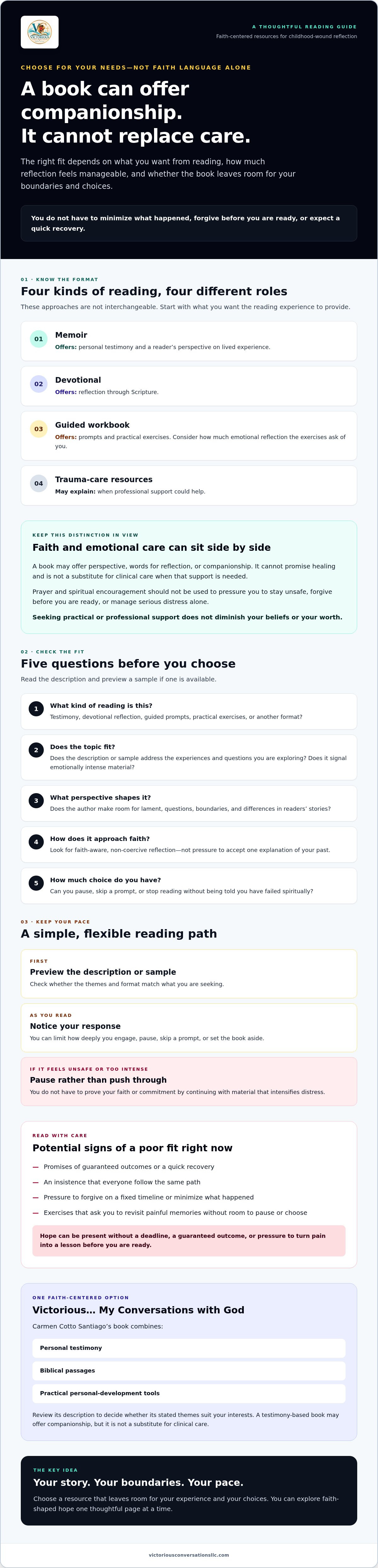
You may want faith to be part of the conversation without being told to minimize what happened, forgive before you’re ready, or expect a quick recovery. A memoir offers personal testimony; a devotional invites reflection through Scripture; a workbook provides guided exercises; and trauma-care resources may explain when professional support could help. These formats aren’t interchangeable, and a book can offer companionship without replacing clinical care.
This guide compares faith-centered reading approaches and offers practical ways to assess fit, emotional demands, and your readiness. Carmen Cotto Santiago’s Victorious… My Conversations with God, for example, combines personal testimony, biblical passages, and practical personal-development tools. Review its description to see whether its stated themes suit your interests. You can explore faith-shaped hope without shame or pressure, one thoughtful page at a time.
Key Takeaways
- Choose among books for healing childhood wounds christian by considering what you need from the reading experience, not faith language alone.
- Assess topic fit, author perspective, reflective demands, approach to faith, and how much control you have over the pace.
- Compare memoirs, devotionals, guided workbooks, and professional resources to find a format suited to your needs and readiness.
- Preview a description or sample, then pause or adjust your pace if the themes feel too intense.
- Consider Victorious… My Conversations with God as a testimony-based option, and review its description to decide whether its themes fit what you’re seeking.
Why Christian books for healing childhood wounds need more than hopeful language
Searching for a faith-centered book about painful early experiences can bring up hope, uncertainty, grief, or the wish to stop searching and try again another day. You don’t have to resolve those feelings before you begin. Christian books can support reflection on childhood pain, but spiritual language alone doesn’t make every resource a good fit.
A book may offer perspective, words for reflection, or a sense of companionship. It can’t promise healing, and it isn’t a substitute for clinical care when that support is needed. As you explore books for healing childhood wounds christian, consider whether a resource leaves room for your experience, boundaries, and choices, as well as what it says about faith.
What readers may mean by childhood wounds
“Childhood wounds” can refer to many experiences, including feeling unseen, loss, conflict at home, or treatment that felt frightening or harmful. These examples aren’t a checklist or a diagnosis. You decide what words fit your story, if any. Some memories may be clear; others may be difficult to name. You can approach them at your own pace. For general background, read about understanding childhood trauma, while remembering that an overview can’t define your personal experience.
How faith and emotional care can sit side by side
Spiritual encouragement can make space for sorrow, questions, and boundaries. Prayer may be meaningful to you, but it shouldn’t be used to pressure you to stay unsafe, forgive before you’re ready, or manage serious distress alone. Practical support and professional care can sit alongside faith. Seeking them doesn’t diminish your beliefs or your worth.
Trauma-sensitive Christian reading is faith-aware, non-coercive, and attentive to reader choice. Look for a resource that lets you pause, skip a prompt, or stop reading without suggesting that you’ve failed spiritually. Notice whether it invites reflection or insists on one interpretation of your past. Hope can be present without a deadline, a guaranteed outcome, or pressure to turn pain into a lesson before you’re ready.
How to evaluate Christian books for healing childhood wounds
Recognizing familiar Scripture or hopeful themes is only a first step. Read the description, preview a sample if available, and check whether the material fits your needs today. SAMHSA offers an authoritative definition of childhood trauma. A book’s description can help you judge whether it addresses the experiences and questions you’re exploring.
Questions to ask before choosing a book
- What kind of reading is this? Is it personal testimony, a devotional, guided reflection, practical exercises, or another format? Knowing what the book asks of you helps you avoid expecting a memoir to work like a workbook or devotional readings to provide individualized care.
- Does the topic fit? Check whether the description or sample names the experiences you’re interested in and signals emotionally intense material. A broad focus on faith or personal growth doesn’t necessarily mean the book discusses childhood experiences.
- What perspective shapes the book? Notice whether the author welcomes lament, questions, boundaries, and differences in readers’ stories, or presents one explanation as right for everyone.
- How much choice do you have? Look for an approach that allows gradual reflection. Can you pause, skip a prompt, or stop reading without being told you’ve failed spiritually?
If the description doesn’t answer these questions, preview more before deciding. For another perspective on testimony-based reading, explore this faith-based trauma healing memoir reader’s guide.
Signs the approach may not fit right now
Be cautious of resources that promise guaranteed outcomes, insist that everyone follow the same path, or pressure you to forgive on a fixed timeline. Consider the exercises, too. Revisiting painful memories may feel manageable for one reader and overwhelming for another. You can limit how deeply you engage or set the book aside.
Pay attention to your response as you read. If the material intensifies distress or feels unsafe, pause rather than pushing through to prove your faith or commitment. Consider reaching out to a qualified professional, especially if difficult feelings persist or interfere with daily life. Reading can be one part of reflection, not a test you must complete.
If you’re interested in personal testimony, Scripture, and practical tools in one reading experience, review the description of Carmen Cotto Santiago’s Victorious… My Conversations with God and decide whether its themes suit your interests. You can also explore faith-centered reading and reflection resources from Victorious Conversations, LLC. Check the book’s description for its specific focus rather than assuming it addresses childhood wounds.
Compare Christian reading options for childhood-wound reflection
Faith-centered resources can serve different purposes, even when they share themes of hope or renewal. A personal story may offer companionship, a devotional may provide a Scripture-based rhythm, and a workbook may ask you to write and reflect. Educational material for helpers has a different audience. Comparing the format and intended reader can help you choose books for healing childhood wounds christian that suit what you’re seeking.
| Resource type | Intended reader | Typical format | Possible benefit | Selection caution |
|---|---|---|---|---|
| Memoir or testimony | Readers seeking personal perspective | Narrative account, sometimes including faith reflections | Companionship and a story to consider | One person’s experience isn’t universal guidance; check the themes first. |
| Devotional | Readers seeking regular spiritual reflection | Short readings, Scripture, and prompts | A steady structure for prayerful thought | A devotional may not explore trauma or early-life experiences in depth. |
| Guided workbook | Readers ready for active reflection | Questions, writing prompts, or exercises | Helps organize personal reflection | Consider whether the prompts feel manageable and optional. |
| Professional resource | Helpers, students, or care providers | Educational material, frameworks, or training content | Can inform how others understand trauma care | It may not be written for personal reflection or provide individual care. |
Memoirs and personal testimony
A memoir shares one person’s account, not a map every reader must follow. It may offer perspective or companionship, but your story can differ. Check the description for themes that match your interests, and don’t assume a book addresses childhood wounds unless that focus is confirmed. Carmen Cotto Santiago’s Victorious… My Conversations with God combines personal testimony, biblical passages, and practical personal-development tools. Review its description to decide whether those themes fit; it isn’t presented here as a verified childhood-wound resource.
Devotionals, workbooks, and trauma-care resources
Devotionals generally provide a structure for spiritual reflection, but Scripture-centered content alone doesn’t show how deeply a book addresses trauma. Workbooks are more participatory: prompts and exercises can organize reflection, but they may require more emotional engagement than narrative reading. Take them at your own pace. Professional resources aimed at helpers or care providers can explain approaches to supporting others, but they serve a different purpose from a personal book and shouldn’t be mistaken for individualized clinical care.
Choose a Christian book that matches your needs and readiness
Start with what you want from reading, not what you think you should be ready to face. Name your need, choose a format, preview the approach, and decide on a manageable pace. You might want a personal story, a brief moment of Scripture-centered reflection, or prompts that help you put thoughts into words. Your needs can change, and your choice can change with them.
Match the format to what you want from reading
- For testimony: Choose a memoir if you want a personal narrative and perspective. Let another person’s story accompany yours, not prescribe what your experience means or what you must do.
- For brief faith-focused reflection: A devotional or Scripture-centered book may suit you if you want a reading rhythm built around short passages and spiritual reflection.
- For guided writing: Consider a workbook when its prompts feel manageable and you can set clear boundaries. Skip questions, write briefly, or stop if an exercise feels too demanding.
If you’re drawn to personal testimony with biblical passages and practical personal-development tools, review Victorious… My Conversations with God by Carmen Cotto Santiago. Check its description to see whether the themes fit what you’re seeking; don’t assume it addresses childhood experiences without reviewing the content. To consider how writing and expression may fit into reflection, read these gentle steps for reclaiming your voice after trauma.
Make a gentle reading plan
Start by previewing one section. Choose a setting where you feel comfortable, and decide in advance when you’ll pause, such as after a few pages or whenever a passage feels heavy. Keep a trusted person or appropriate professional support option in mind if difficult emotions arise. You don’t need to finish a chapter to prove you’re making progress.
Let your response guide the pace. If reading brings up more than you can comfortably manage, close the book and take a break. You can return later, choose a different format, or stop altogether. Those are valid choices, not signs of weak faith. A suitable resource is one you can approach with choice and respect for your limits.
To explore the faith-centered memoir and decide whether its themes suit your reading goals, review the memoir’s description.
Consider Victorious… My Conversations with God as one faith-centered option
If you value personal testimony alongside biblical reflection, Victorious… My Conversations with God by Carmen Cotto Santiago may be worth considering. The memoir combines the author’s testimony, biblical passages, and practical personal-development tools. That blend may suit readers looking for a reflective experience shaped by faith rather than a devotional or workbook alone.
A faith-centered memoir isn’t automatically a fit for every reader. The available information confirms its format and elements, but doesn’t establish that it specifically addresses childhood wounds. If you’re comparing books for healing childhood wounds christian, review the description and consider whether the stated themes, perspective, and approach feel relevant and comfortable. Personal testimony offers one perspective to consider, not a universal guide or a promise of a particular result.
Who may appreciate a faith-centered memoir
Readers who welcome a personal story alongside Scripture may appreciate the blend of testimony and reflection. Others may prefer material focused on childhood experiences, short devotional readings, or prompts designed for their own writing. There’s no single right choice. Compare the memoir’s description with what you’re looking for, and consider whether you feel ready for that kind of reading.
Victoriosa… Mis Conversaciones con Dios is also a confirmed Spanish-language title offered by Victorious Conversations, LLC. Review its description for details about the content rather than assuming specific themes or features.
When reading may need additional support
Reading personal stories or reflecting on painful memories can bring up unexpected emotions. If you feel intensely distressed, unsettled, or unable to manage daily activities, you deserve care, not self-blame. Consider speaking with a qualified mental-health professional about support suited to your circumstances. A memoir may accompany personal reflection, but it isn’t psychotherapy or clinical counseling and can’t replace that care.
You’re allowed to read slowly, set the book aside, or choose another resource. Those choices don’t mean you’ve failed; they honor your needs and limits. To learn more, review the Victorious Conversations book and resources and decide whether the described themes fit your interests and comfort level.
Choose a next step that honors your pace
The right faith-centered reading choice depends on what you need now: a personal story, Scripture-led reflection, or guided writing. Compare each book’s themes and approach, and give yourself permission to pause, skip a prompt, or choose another resource if the material feels too heavy. Reading may support reflection, but it can’t guarantee healing or replace clinical care when that’s needed.
If you’re exploring books for healing childhood wounds christian, consider Victorious… My Conversations with God by Carmen Cotto Santiago as one possible memoir. It combines personal testimony, biblical passages, and practical personal-development tools. Review its description to see whether the themes fit rather than assuming it specifically addresses childhood wounds. Victoriosa… Mis Conversaciones con Dios is also offered as a Spanish-language title.
Explore Victorious Conversations’ books and resources and review the descriptions to decide whether a title fits your reading goals. Your pace is yours to choose, including when you need to pause or seek support.
Frequently Asked Questions
Can Christian books help heal childhood wounds?
Christian books may support reflection, offer spiritual encouragement, or help readers find language for their experiences, but they can’t guarantee healing. The right book depends on its content and your needs. Look for an approach that respects your pace and leaves room for questions and boundaries. If painful memories affect your well-being, reading can sit alongside appropriate professional support, not replace it.
What should I look for in a Christian book about childhood wounds?
Look for a clear description of the book’s focus, format, author perspective, and emotional demands. Preview a sample, if available, to see whether it discusses painful memories and whether reflection feels gradual or intense. Notice how it treats lament, questions, boundaries, and individual differences. A book that lets you pause, skip prompts, or stop may offer more choice than one that prescribes a single path.
Are Christian memoirs or devotionals better for reflecting on childhood pain?
Neither is automatically better; each offers a different reading experience. A memoir shares one person’s story and may offer perspective or companionship, but it isn’t a prescription for your life. A devotional usually provides shorter, Scripture-centered reflections, though it may not explore childhood pain in depth. Decide whether you want a narrative, brief spiritual reflection, or another format, then preview the material to assess fit.
Can reading about childhood wounds make difficult feelings stronger?
Yes, reading or reflecting on painful experiences can bring up difficult feelings, though each person responds differently. Preview a small section, read in a comfortable setting, and pause if you feel overwhelmed. You can skip an exercise or close the book. If distress continues, feels unsafe, or interferes with daily life, reach out to a qualified mental-health professional or trusted support person.
Is a Christian healing book a substitute for therapy?
No. A book may offer testimony, Scripture, or prompts for personal reflection, but it isn’t psychotherapy or clinical counseling and can’t provide individualized care. If ongoing distress affects your daily life, consider talking with a qualified mental-health professional about support suited to your situation. Faith and professional care can coexist. Choosing both doesn’t mean your faith is inadequate or that you’ve failed to manage your feelings.
What if a Christian book pressures me to forgive before I am ready?
You don’t have to accept a book’s timeline or interpretation of forgiveness as a rule for your own life. If its language makes you feel pressured, unsafe, or blamed, pause and consider another resource. You can set boundaries and seek support without forcing a decision. A faith-centered approach can make room for grief, questions, and your need for safety rather than demanding a quick resolution.
Does Victorious… My Conversations with God specifically address childhood wounds?
The confirmed information describes Victorious… My Conversations with God by Carmen Cotto Santiago as a memoir combining personal testimony, biblical passages, and practical personal-development tools. It doesn’t establish that the book specifically addresses childhood wounds, so review its description and content before deciding whether its themes fit your needs. Victoriosa… Mis Conversaciones con Dios is also a confirmed Spanish-language title.


